
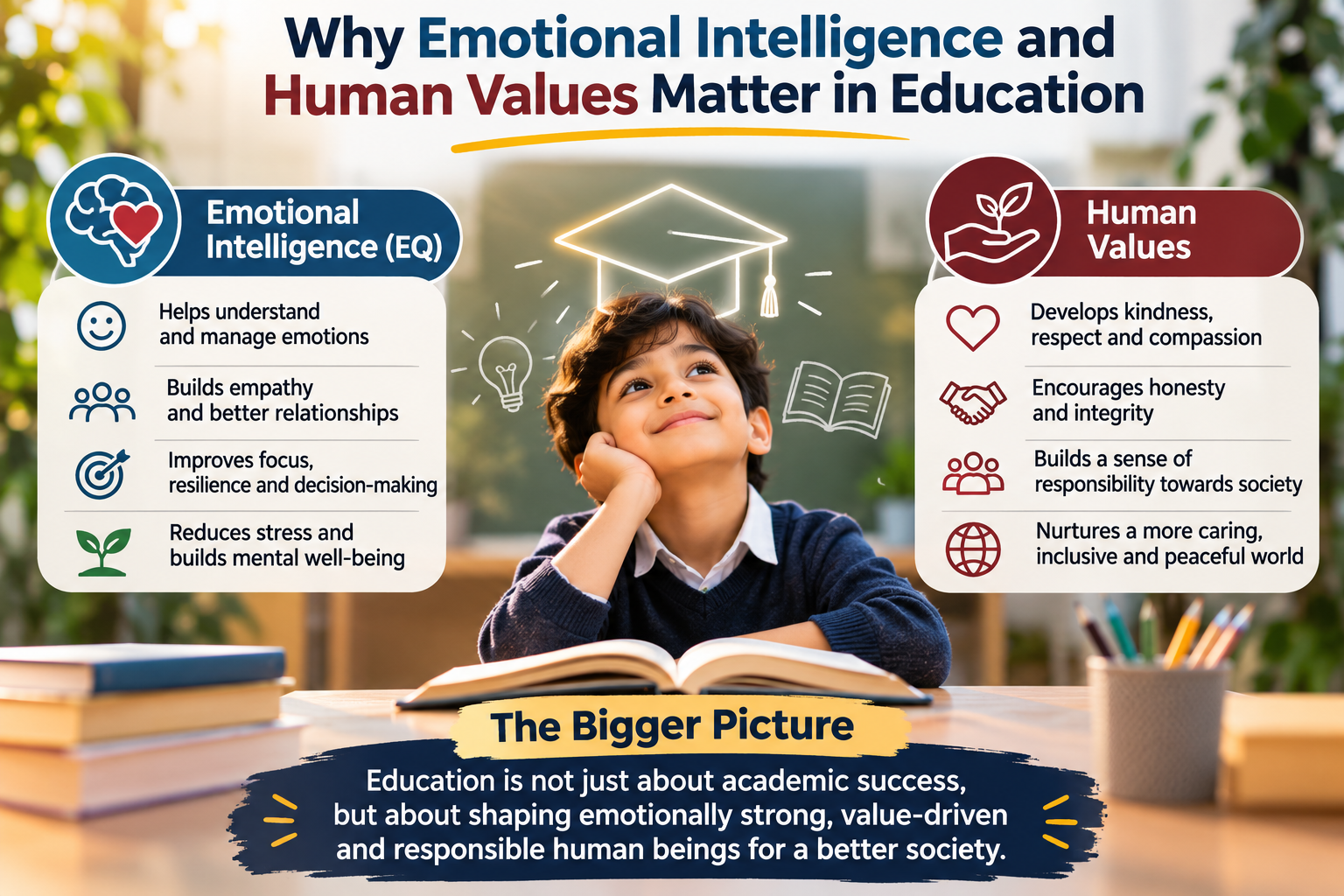
Emotional Intelligence in Education: Developing More Than Academic Skills
A student may perform well in examinations and understand complex subjects, yet still find it difficult to manage frustration, communicate feelings, or resolve disagreements.
This highlights an important dimension of education: learning is not only about what we know, but also about how we understand ourselves and relate to others.
Emotional intelligence and human values are important parts of a holistic approach to education. They can help learners develop greater self-awareness, empathy, communication skills, and a sense of responsibility.
What Is Emotional Intelligence?
Emotional intelligence refers broadly to the ability to recognize, understand, and manage emotions, as well as to understand emotional cues in other people.
In educational settings, this can involve learning to identify feelings, communicate respectfully, manage disagreements, and consider different perspectives.
For example, a student who feels disappointed after receiving a low mark can learn to recognize that disappointment without allowing it to define their abilities. They can then reflect on what went wrong and identify practical ways to improve.
This is one way emotional understanding can support learning and personal growth.
Why Is Emotional Intelligence Important in Education?
1. It encourages self-awareness
Recognizing emotions and behavioural patterns helps students better understand their responses to success, failure, pressure, and change.
2. It supports healthier relationships
Empathy and respectful communication can help students understand different perspectives, work collaboratively, and navigate disagreements constructively.
3. It helps develop thoughtful responses
Learning to pause before reacting can help students approach challenging situations with greater consideration.
4. It supports responsible decision-making
When learners consider the effects of their choices on themselves and others, they can begin to develop a stronger sense of responsibility.
What Is the Role of Human Values in Education?
Human values provide a practical foundation for how we treat ourselves and others.
Values such as honesty, compassion, integrity, respect, patience, and responsibility are not simply concepts to memorize. They become meaningful when learners can recognize and apply them in everyday situations.
For example:
- Honesty means acknowledging a mistake instead of hiding it.
- Respect means listening to someone even when we disagree.
- Responsibility means recognizing the consequences of our actions.
- Compassion means considering another person's experience before judging them.
Education can create opportunities for learners to reflect on these values and understand how they apply in real life.
How Can Parents and Teachers Encourage Emotional Learning?
Parents and educators can support emotional learning through ordinary interactions and everyday experiences.
Encourage open conversations. Give children opportunities to express their feelings without immediately dismissing or judging them.
Model the behaviour you wish to encourage. Children observe how adults handle disagreements, frustration, mistakes, and responsibilities.
Ask reflective questions. Instead of simply asking what happened, ask what the child felt, what they learned, and what they might do differently next time.
Create opportunities for cooperation. Group activities, shared responsibilities, and collaborative problem-solving can encourage listening, empathy, and respect.
Connect values with real situations. Discuss how honesty, fairness, and compassion apply to choices children encounter at home and in school.
Bringing Emotional Intelligence and Conscious Learning Together
Conscious learning encourages learners to observe their thoughts, understand their responses, and reflect on the consequences of their actions.
When combined with emotional intelligence and human values, it creates a broader framework for considering the purpose of education.
At Kaliyuga Gurukul for Conscious Learning, this perspective is central to the belief that education should nurture the whole human being. Academic development matters, but so do self-understanding, relationships, character, and responsible living.
Education That Connects Knowledge With Life
The purpose of education extends beyond preparing students for examinations. It can also help them develop the awareness and practical abilities needed to navigate everyday life.
By making space for emotional understanding, human values, and conscious reflection, educators and families can contribute to a more holistic learning experience.
Education becomes more meaningful when learners are encouraged not only to understand the world around them, but also to understand themselves.
Discover how Kaliyuga Gurukul approaches conscious learning, value-based education, and human development.