Education is often measured through marks, examinations, qualifications, and professional achievements. These are important aspects of learning, but do they tell us everything about a person's development?
Can education also help us understand our emotions, build meaningful relationships, make responsible decisions, and become more aware of ourselves?
This is where conscious learning offers a broader perspective on education.
At Kaliyuga Gurukul for Conscious Learning, we believe that learning should go beyond acquiring information. It should encourage individuals to understand themselves, reflect on their choices, and apply knowledge with awareness in everyday life.
What Does Conscious Learning Mean?
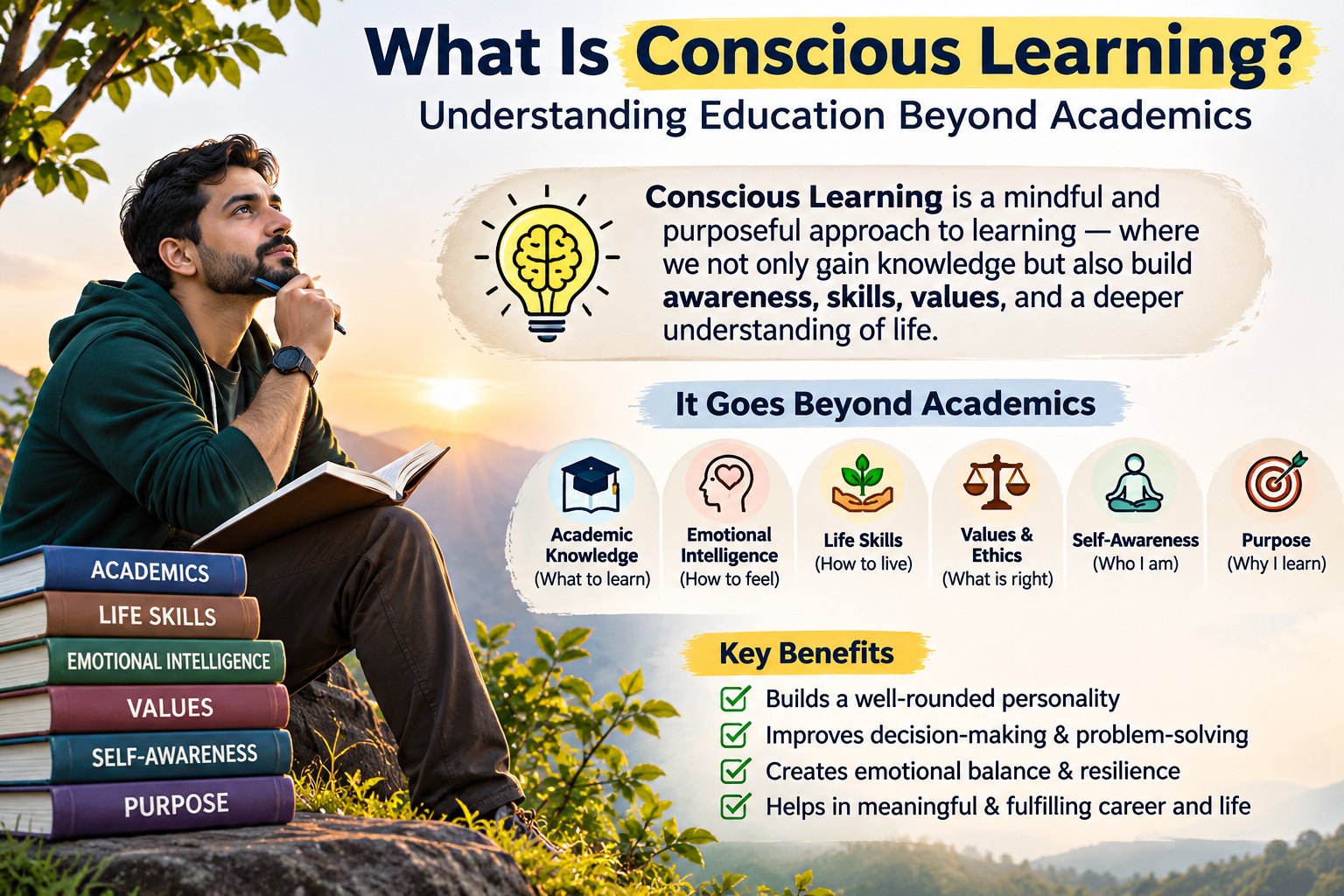
Conscious learning is an approach that encourages people to learn with awareness, curiosity, and reflection. It involves not only understanding what we learn, but also examining how that knowledge influences our thoughts, actions, relationships, and decisions.
For example, learning about honesty becomes more meaningful when a person reflects on what honesty looks like in everyday situations. Similarly, understanding emotions becomes more valuable when we learn to recognize our feelings and respond thoughtfully rather than react automatically.
In this way, learning becomes connected to life itself.
Why Does Modern Education Need a Holistic Approach?
Academic knowledge provides a foundation for professional and intellectual growth. However, human development also involves emotional understanding, values, self-discipline, empathy, and responsibility.
A holistic approach to education can help learners explore these interconnected dimensions.
1. Self-awareness
Understanding our thoughts, emotions, strengths, limitations, and behavioural patterns can help us make more conscious choices.
2. Emotional intelligence
Recognizing emotions and responding constructively can support healthier relationships and better communication.
3. Human values
Values such as integrity, compassion, respect, and responsibility become meaningful when they are practised in everyday life.
4. Critical reflection
Asking questions, examining assumptions, and learning from experiences can help individuals develop a deeper understanding of themselves and the world.
The Connection Between Ancient Wisdom and Modern Learning
Ancient Indian wisdom traditions explored questions about self-understanding, conduct, discipline, and the meaning of life. Modern approaches to education also increasingly recognize the importance of emotional, social, and personal development alongside academic learning.
Conscious learning creates an opportunity to explore these dimensions together without limiting education to a single method or tradition.
The objective is to make learning practical, inclusive, and relevant to the challenges people face today.
How Can We Practise Conscious Learning in Everyday Life?
Conscious learning does not always require a classroom or a formal program. It can begin with small, intentional practices.
- Reflect on your actions and decisions at the end of the day.
- Listen to others without immediately preparing a response.
- Observe your emotions before reacting to difficult situations.
- Ask what a particular experience has taught you.
- Practise values through everyday choices rather than treating them as abstract ideas.
Over time, these practices can make learning a more active part of daily life.
The Kaliyuga Gurukul Perspective
Kaliyuga Gurukul for Conscious Learning is a consciousness and value education movement that brings together ancient wisdom, emotional intelligence, human values, and modern learning.
Its philosophy is rooted in the belief that education should support the development of the whole human being, not only academic performance.
Because education becomes more meaningful when knowledge is accompanied by awareness, understanding, and responsible action.
Explore the philosophy of Kaliyuga Gurukul and discover a broader perspective on conscious learning and human development.